
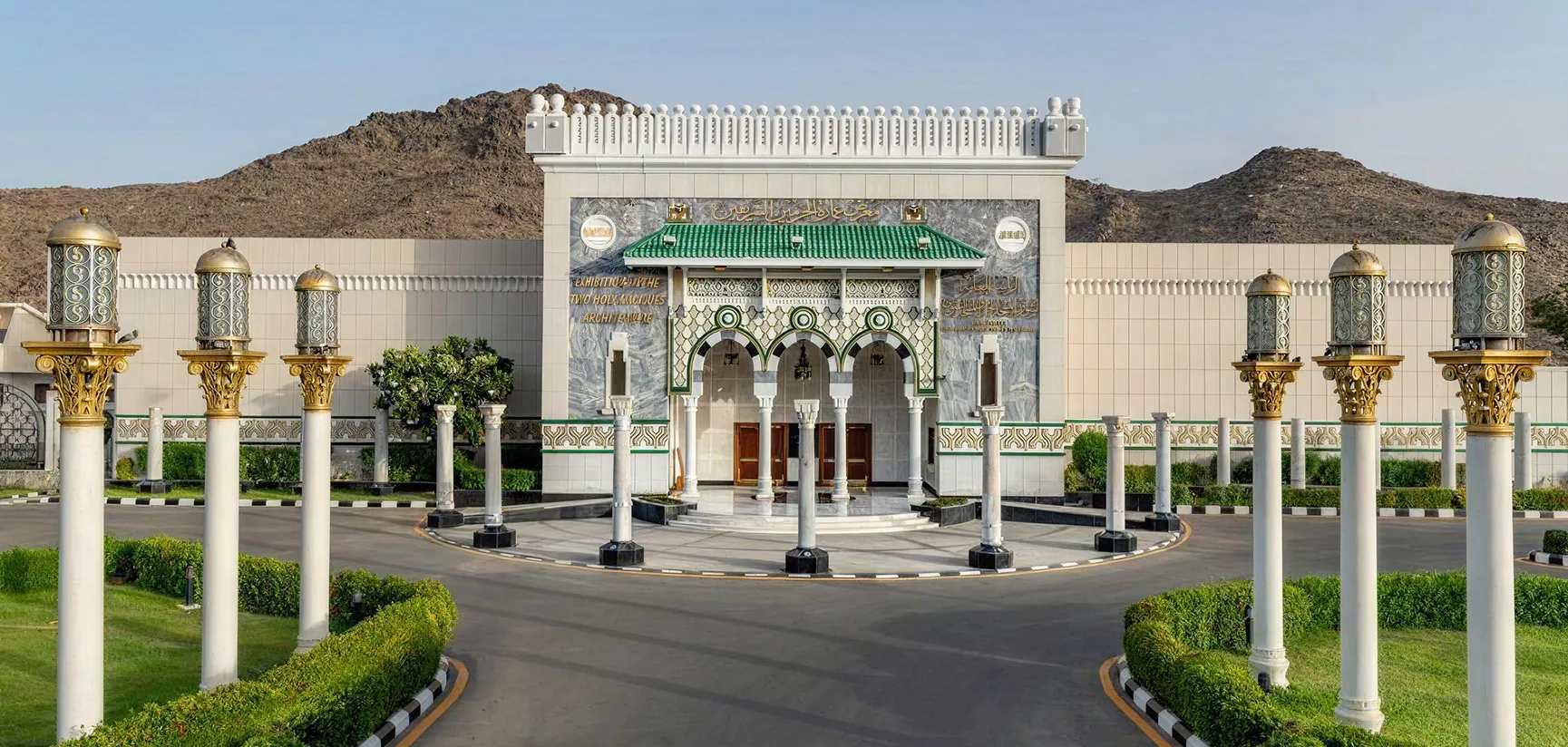
In Makkah, near the Grand Mosque, the Exhibition of the Two Holy Mosques’ Architecture documents centuries of architectural beauty and the dedicated service provided to the Grand Mosque in Makkah and the Prophet’s Mosque in Madinah. From the moment visitors enter the museum, they begin an exceptional journey through galleries that tell the story of the development of the Two Holy Mosques, beginning with the early Islamic eras, continuing through the Umayyad and Abbasid periods, and reaching the modern era under the care of the Kingdom of Saudi Arabia, which witnessed the largest expansions in the history of the Holy Mosque. The exhibition reflects a deep appreciation for Islamic heritage and allows visitors to understand the evolution of Islamic architecture throughout the centuries.
Exhibition Layout and Galleries
The exhibition consists of seven main galleries, each dedicated to a specific category of exhibits, providing a comprehensive educational and cultural experience:
Reception Hall: Gives visitors an overview of the architecture and expansions of the Two Holy Mosques through a modern scale model of the Grand Mosque and a collection of historical photographs.
Grand Mosque Gallery: Displays rare artifacts, including the staircase of the Holy Kaaba, which is more than 200 years old, as well as the enclosure of Maqam Ibrahim (Station of Ibrahim).
Holy Kaaba Gallery: Features valuable artifacts, including the door of the Holy Kaaba commissioned by King Abdulaziz Al Saud, one of the interior columns of the Kaaba dating back to the era of the Companion Abdullah ibn Al-Zubair, may Allah be pleased with him, and the Kaaba’s Mizab (water spout).
Photography Gallery: Documents the development of the Two Holy Mosques through historical and photographic images.
Manuscripts Gallery: Contains rare Qur’anic manuscripts and copies of the Holy Qur’an, including a copy of the Uthmanic Qur’an believed to date back more than 1,400 years.
Prophet’s Mosque Gallery: Displays models and artifacts from the Prophet’s Mosque, most notably the Ottoman minbar (pulpit).
Zamzam Gallery: Features parts of the Zamzam Well opening and its cover, along with a model illustrating the well in detail.
Architectural Style and Visitor Experience
The exhibition was designed in harmony with Islamic architectural traditions, reflecting the identity of the Two Holy Mosques through domes, intricate ornamentation, and arches. It is an ideal destination for families, researchers, and knowledge seekers, offering well-documented information and explanatory panels in several languages. Specialized guides also enrich the visitor experience by providing accurate historical and architectural context, making the visit a rich educational and cultural experience.